

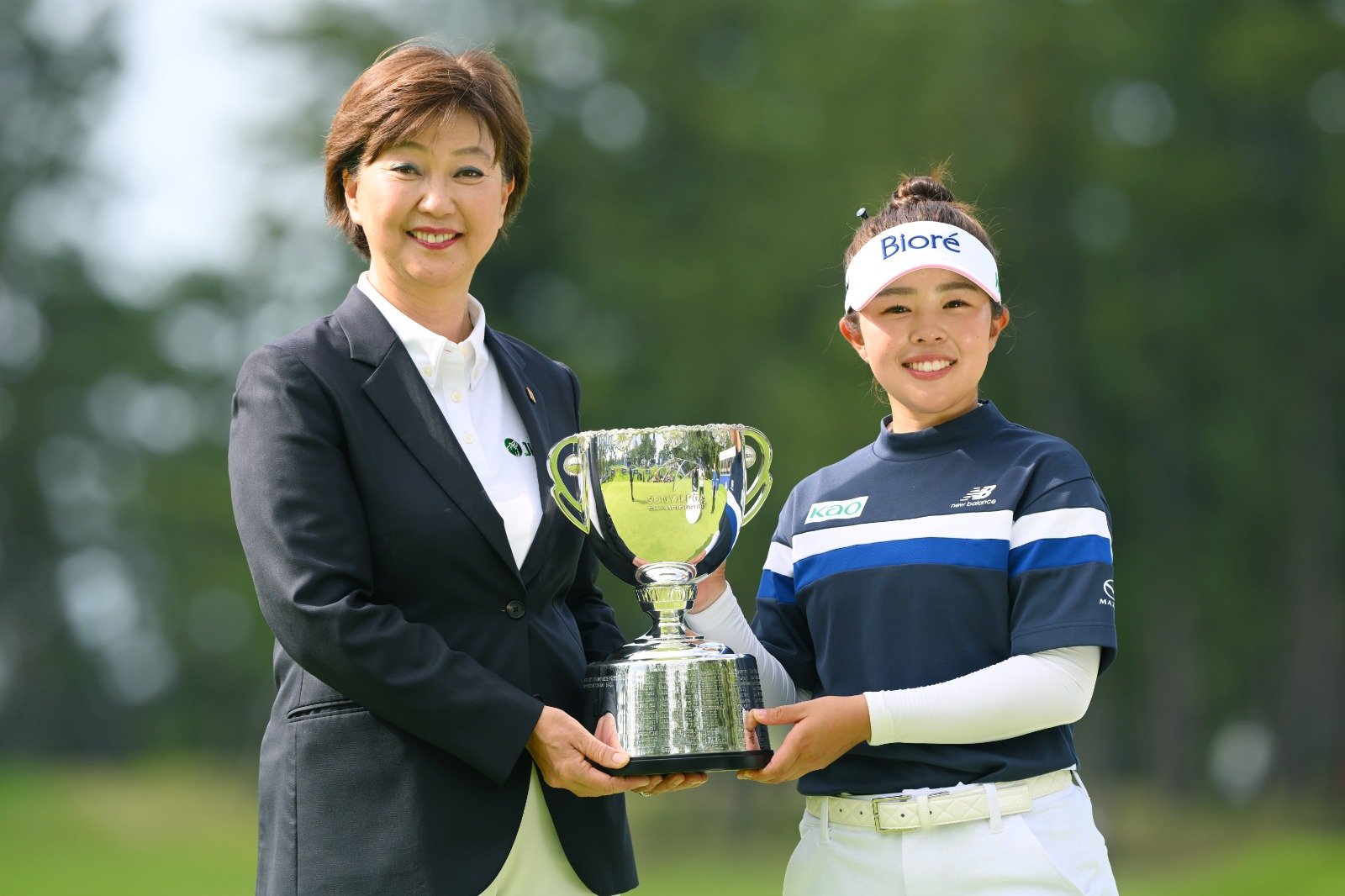
The emerging strength and depth of the Japan Ladies Professional Golf Association (JLPGA) has been on full display at last week’s SONY JLPGA Championship, where Japan’s leading players competed alongside emerging talent and international major champions at Katayamazu Golf Club.
Related: Miyuu Yamashita wins playoff to clinch Sony JLPGA Championship
JLPGA Chairman Hiromi Kobayashi believes the strength of the field reflects more than the quality of the players competing. It is the result of more than a decade of investment in raising the standard of competition in Japan under the JLPGA’s long-term ambition to “Win the World.”
Of the 15 Japanese players primarily competing on the LPGA Tour in the United States this season, 11 are in the field this week. Meanwhile, the domestic Tour has produced 20 different winners in its first 25 tournaments, including six first-time champions.
View this post on Instagram
“We’re seeing different players win almost every week, and more and more young, talented players are emerging,” said Kobayashi. “This kind of growing excitement and competitiveness across the Tour each year is leading to greater depth in the player field.”
A key part of the JLPGA’s Tour Strengthening Measures has been the gradual introduction of more four-day tournaments. Since 2013, the number has steadily increased, with 21 of the Tour’s 37 tournaments now played over four rounds.
Kobayashi believes the change has helped players develop the physical, technical, mental and strategic skills required to compete at the highest level.
“Players have developed the physical strength and technical skills needed to compete over four days, as well as learning how to manage and compete in four-day tournaments,” she said.
View this post on Instagram
“That is why, even when they compete in major championships overseas, they are able to compete in much the same way as they do on the domestic Tour.”
The JLPGA has also upgraded practice facilities at tournament venues, introduced a re-ranking system to heighten competition and broadened course setups to test different aspects of players’ games. More than 30 statistical categories are now tracked, giving players greater insight into their performances and areas for improvement.
Kobayashi believes these measures have significantly raised the standard of the domestic Tour, with the results increasingly evident on the international stage.
Since 2019, six Japanese players have won major championships around the world, while Japanese players have also been regular winners on the LPGA Tour in recent years.
“As we have made these improvements, the players’ overall abilities, including their physical, mental, and technical skills, have continued to develop,” Kobayashi said. “The domestic Tour has also become increasingly competitive and vibrant each year, and since 2019, six players have gone on to win major championships around the world.”
View this post on Instagram
The return of leading Japanese players from overseas is also helping accelerate that development, providing younger players with the opportunity to compete alongside established stars and measure themselves against the highest level of the game.
“The increased competitiveness of the domestic Tour means that the players inspire each other and push each other to raise the quality of their golf,” said Kobayashi. “I feel that this creates a significant positive cycle, increasing both the value of winning and their motivation to win.”
That intensity is reflected in the challenging setup at Katayamazu Golf Club this week. With fairways narrowed, rough extended to 80 millimetres and demanding pin positions introduced under the supervision of professional golfer Chikayo Yamazaki, the championship is placing a premium on precision, distance control, accuracy, putting and short-game skills.
“I feel that bringing out the players’ full physical, mental, and technical abilities in this way is also contributing to their success in overseas major championships,” Kobayashi said.
The championship is simultaneously providing a platform for the next generation. Six players around the age of 20 have recorded their first JLPGA Tour victories this year, while 12 winners from the JLPGA Step Up Tour are competing this week.
“By being inspired by the quality of golf demonstrated by top players who are competing successfully both in Japan and overseas, these young players can set their sights higher, thinking, ‘Next time, I want to be the one to win,’” Kobayashi said.
The presence of international major champions, including 2020 US Women’s Open winner, Kim A Lim from South Korea, further raises the stature of the SONY JLPGA Championship. Kobayashi believes winning against players who have succeeded on the world’s most competitive tours provides a true measure of ability and an opportunity to leave a lasting mark on Japanese women’s golf.
The championship itself has also evolved, moving beyond its original role of determining the best professional golfer in Japan to become a major championship representing Asia. A new exemption category for female professional golfers from Asian regions recognised by the JLPGA has enabled players from across the continent to compete each year.
“I think it’s a wonderful system, and I was able to compete here because of this opportunity. I would like to come back again and also definitely recommend it to other players,” said Kim.
Kobayashi hopes the event can continue that evolution and become a championship that professionals across Asia aspire to win.
Looking further ahead, the JLPGA’s ultimate benchmark is the PGA TOUR.
“It is still a very distant benchmark for us, but we are working to get even a little closer by improving the Tour environment and its entertainment value, while also pursuing a more diverse and multifaceted sports business,” said Kobayashi.